Market Inspectorate (Agoranomia)
To understand why the Market Inspectorate must return as an active body, we must look at the historical mistake of the past.
Until the year 2000, the Market Inspectorate operated as a self-standing, powerful department within the Police Directorates of each prefecture. It was the terror of profiteers. Its officers went out into the market every day, checked the scales in the grocers', the prices in the restaurants, the quality in the butchers' and the adulteration of fuels. [1]
1. The “crime” of the abolition (2000)
By Presidential Decree 101/2000, the government of the time abolished the Market Inspectorate Departments of the Police. The justification was that the inspections would pass to “civilian” bodies then being set up (such as EFET, the Single Food Control Agency, and the services of the Prefectural Authorities). [1, 2]
The reality: The new services were staffed by desk employees. They had neither the training, nor the authority, nor the jurisdiction of the Police to make on-the-spot arrests and seize goods.
The result: An enormous enforcement gap was created. The market was left entirely unchecked, the middlemen started profiteering without fear, and we reached today's unbridled inflation. [1]
2. How the new Market Inspectorate will work per Police Directorate
With the new Act of Legislative Content, we restore the old, strict model but with modern, digital tools. The Market Inspectorate Departments are re-founded within each one of the country's 54 Police Directorates. [1]
The uniformed market-inspection officers will have the exclusive competence to establish 4 specific categories of serious offences:
Offence 1: Exceeding the profit cap (profiteering)
What was happening: Supermarkets and wholesalers bought milk at €0.40 from the farmer and sold it at €1.80 to the consumer.
What will apply: The Market Inspectorate will check the purchase invoices. If the profit margin exceeds the percentage set by the state, an automatic fine is imposed and an in-flagrante procedure is triggered.
Offence 2: Artificial hiding of products (monopoly)
What was happening: Large traders hid products in their warehouses (e.g. olive oil, wheat) to create an artificial shortage and drive prices up.
What will apply: The officers have the right to immediate raid and sealing of the warehouse. The hidden products will be seized and put on the market at cost price. [1]
Offence 3: Adulteration & misleading of the consumer
What was happening: Passing off foreign products as Greek (e.g. meat or potatoes imported cheaply and re-labelled “Greek”) and adulteration of fuels.
What will apply: Immediate sealing of the shop or petrol station and withdrawal of the licence.
Offence 4: Failure to display price lists and false discounts
What was happening: Shops and tourism businesses hid prices or showed fictitious discounts to trap citizens.
What will apply: Strict administrative fines on the spot.
With the Police back on the streets of the market, every profiteer will know that if they cheat the citizen out of even one cent, they will face the in-flagrante procedure and the closure of their business.
For the full and effective staffing of the new Market Inspectorate across the territory, exactly 816 officers are required out of the 5,000 who are being recalled. This means the measure is implemented immediately without costing the state a single extra euro, while the remaining 4,184 front-line officers return immediately to the neighbourhoods (police stations, rapid response, the DIAS motorcycle unit) to reinforce citizens' sense of security.
The distribution of the 816 officers among the country's 54 Police Directorates is based on the population and the commercial activity of each prefecture:
Detailed staffing plan of the Market Inspectorate
Large urban Directorates (6 in total): 240 officers
Areas: Athens, Piraeus, North Attica, West Attica, East Attica and Thessaloniki.
Staffing: 40 officers per Directorate (split into 4 active squads of 10 for 24-hour patrols and inspections in central markets, ports and department stores).
Medium & provincial Directorates (48 in total): 576 officers
Areas: All the remaining prefectures of the country (e.g. Larissa, Achaia, Heraklion, Ioannina, Evros, etc.).
Staffing: 12 officers per Directorate (split into 2 squads of 6, sufficient for daily inspections in local shops, farmers' markets and workshops).
Why does this number guarantee the end of profiteering?
With 816 trained, uniformed officers on the streets, the country acquires, for the first time since 2000, a permanent enforcement mechanism with the power of in-flagrante arrest.
Profiteers will no longer be dealing with “desk employees” who simply write a report, but with the Police, who will seal the shop and take the offender to the Prosecutor within a few hours.
The total economic benefit for the state from the re-operation of the police Market Inspectorate is estimated at €60,000,000 for the first half-year and reaches €120,000,000 on an annual basis.
To calculate this amount with absolute precision, we use a Double-Return Model (direct revenue from fines + indirect revenue from VAT and taxation).
The mathematical method of calculation
1. Direct revenue from market-inspection fines (€20,000,000 per half-year)
The 816 officers form about 100 active, daily inspection squads across Greece.
Number of inspections: Each squad carries out 5 thorough inspections a day (wholesale, supermarkets, warehouses). A total of 500 inspections a day nationwide.
Half-year total: 500 inspections × 150 working days per half-year = 75,000 inspections.
Offence rate: Given the licence of the market, it is estimated that 5% of the inspections (3,750 cases) will concern serious offences (profiteering, re-labelling of foreign goods, hiding of information).
Fine collections: With the provision for a “fine equal to five times the illegal profit”, the average steep fine is set at €5,330.
Calculation: 3,750 offences × €5,330 average fine = €20,000,000.
2. Indirect revenue from VAT & the rooting out of the black market (€40,000,000 per half-year)
This is the biggest gain for the public purse.
The phenomenon: When traders know that the Police check purchase invoices and warehouses 24 hours a day, they are forced to stop fictitious sales and to issue legal receipts to justify their stock.
The benefit: The compulsory legalisation of transactions in the supply chain brings a minimum increase of 1.5% in the official collection of VAT in the food and basic-goods sector.
Calculation: This legalisation translates into an additional €40,000,000 of net VAT revenue that would have ended up in the shadow economy.
Total fiscal return of the Market Inspectorate
| Revenue source | Benefit, 1st half-year | Annual benefit |
|---|---|---|
| Direct revenue (confirmed fines of 5× profit) | €20,000,000 | €40,000,000 |
| Indirect revenue (new VAT from fear of inspections) | €40,000,000 | €80,000,000 |
| TOTAL GAIN | €60,000,000 | €120,000,000 |
Note: The staffing cost is zero, as the 816 officers are already paid by the state and are simply moved from the pointless protection details of politicians.
What the newspaper TO VIMA wrote, 24.11.2008, 22:59
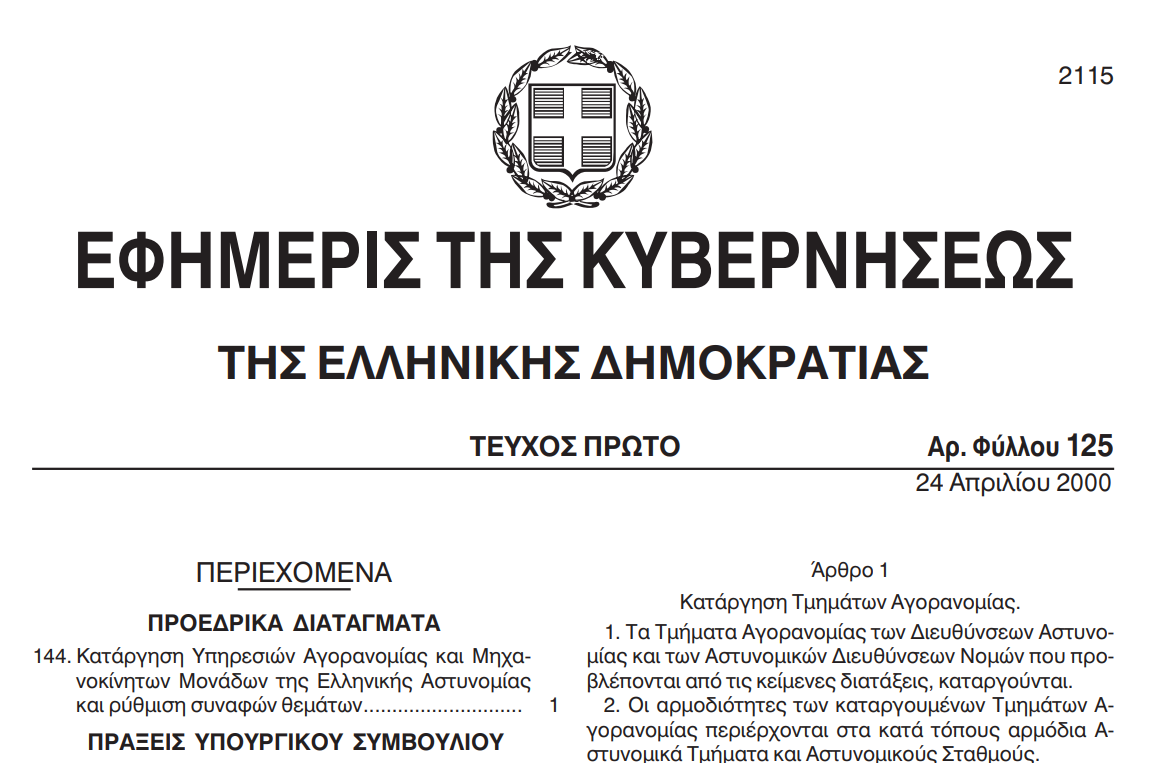
The great gap in the Market Inspectorate
The significant gap expected in the coming months in the way the production and distribution of food to the consuming public is monitored is causing constant concern among senior officers of the Hellenic Police and among market officials. The significant enforcement deficit will be created after the abolition (from 1 January 2000) of the Market Inspectorate services of the Police, in view of the founding of the Single Food Control Agency (EFET). But while one service is being abolished, its “replacement” does not… exist! It will start operating, according to the estimates of the officials of the Ministry of Trade, in five to eight months. At the same time, officers of the Market Inspectorate, in a letter they sent to “To Vima”, allege that “with this action the citizen is left literally unprotected, fed with contaminated and unfit-for-consumption food and adulterated products”!
According to the planning of the Ministry of Public Order and the joint decision with the Ministry of Trade on 24.12.1999, after the dissolution of the Market Inspectorate services the officers who staffed those services will be distributed among departments of Attica, in order to carry out inspections in local markets with non-specialised officers. But as officers who know the secrets of the market and the way officers are dispersed estimate, this manner of inspection will be ineffective. On the one hand because the former Market Inspectorate officers — about 30 people — are fewer than the 65 departments of East and West Attica, and on the other because there is no groundwork in the departments for the operation of these inspection squads. So in 60% of the departments there will be no specialised officer, and even where there is one the inspections will not be sufficient…
“The service's veterinary inspectors, with their immediate intervention and the jurisdiction they had to ascertain and certify the fitness or otherwise of foods and to give opinions accordingly on the destruction or seizure of suspect foods, contributed to limiting as far as possible the distribution of unsuitable products to the consuming public. Thus, once again, the state's characteristic indifference towards the citizen who suffers daily is quite clear. In contrast to the indirect care it provides to the cunning professionals who supply the market and the consumer with their problematic products so that they can continue to profiteer at the expense of unsuspecting consumers,” note Market Inspectorate officers in the letter they sent to “To Vima”.
On the other hand, staff of the Ministry of Public Order and of the Ministry of Trade express the view that there will be no gap in the monitoring of the market, since the competent services of the Prefectural Authorities and the Public Health inspectors will continue to be active. However, the answer from responsible officers is that the many years of inspections by the Market Inspectorate services demonstrate that “the presence of an inspecting officer counts differently for the law-breaking trader”. Finally, the president of EFET, Mrs Christina Papanikolaou, stressed that there is a further agreement with the Ministry of Public Order for the absorption of the Hellenic Police veterinary inspectors into the new food control body.
Fuel smuggling
Fuel smuggling is the largest, most organised and most chronic “haemorrhage” of Greece's fiscal revenue. While ordinary citizens pay for fuel with outrageous taxes (SCT and VAT) at the pump, the large networks, with the assistance of “white collars” and corrupt state officials, steal from the state over €300,000,000 per half-year (€600 million a year).
Putting on again the uniform of the “Greek FBI”, we expose the 3 main methods of the fuel mafia and set out the radical measures of the new government:
1. The 3 methods of the looting in fuels
Method A': The trick with marine & export diesel
The fraud: Diesel for ships (marine) and diesel intended for export to neighbouring countries has zero or minimal tax. The networks produce fictitious documents that the diesel was loaded onto a ship or exported.
The reality: The diesel never leaves the country. It is diverted secretly by tanker trucks to ordinary petrol stations and sold as normal transport diesel, with the networks pocketing the entire Special Consumption Tax (SCT).
Method B': Disabling the input–output systems
The fraud: Theoretically, all petrol stations are required to have electronic systems that measure how much fuel enters the tanks (inputs) and how much is sold from the pumps (outputs), sending the data to the tax authority (AADE).
The reality: The networks install special illegal software (data-tampering systems), which “doctor” the measurements or erase entire tanker deliveries from the state's view. Thus they sell thousands of litres “off the books”, without receipts and without taxes.
Method C': Adulteration with solvents
The fraud: Chemical solvents (used in paint industries), which have no fuel tax, are legally imported from abroad.
The reality: These solvents are mixed with petrol in the tanks of the petrol stations. The consumer pays for expensive petrol, destroys their engine, and the mafia earns millions by evading tax.
2. The radical measures
To turn off the tap, the new government applies 3 instant control measures:
Satellite tracking & GPS on all tanker trucks (within 15 days): Every tanker truck in the country (domestic or transit) is required to carry a sealed GPS device connected directly to the operations centre of the Market Inspectorate and the Financial Police. If the vehicle deviates from its route or stops at a suspicious warehouse, an alarm is triggered and an immediate raid takes place.
Universal digitisation of refineries: Control of the flow from the first drop. The input–output systems are locked with state cybersecurity software that cannot be breached by private parties.
The “economic death penalty” measure: If a petrol station is found with adulterated or smuggled fuel, a fine is not merely imposed. The station is permanently sealed within 24 hours, the licence is withdrawn for life, the fuel is seized, and the names of the owners are made public.
3. Fiscal benefit from rooting out smuggling
With the immediate application of these measures, the state manages to recover at least 50% of the lost revenue from the very first half-year:
- Net gain, 1st half-year: €150,000,000
- Annual gain: €300,000,000
📊 The new grand total of the Memorandum
If we add these €150,000,000 to the previous benefits, our programme jumps:
- New total of savings, 1st half-year: €985,500,000 (almost €1 billion!)
- New annual benefit: €1,931,000,000 — APPROXIMATELY €2 BILLION.
These extra €150 million from fuel the new government decides to put entirely into the “Fighting inflation” heading, allowing an even bigger reduction in the prices of petrol and diesel for all Greek citizens.